
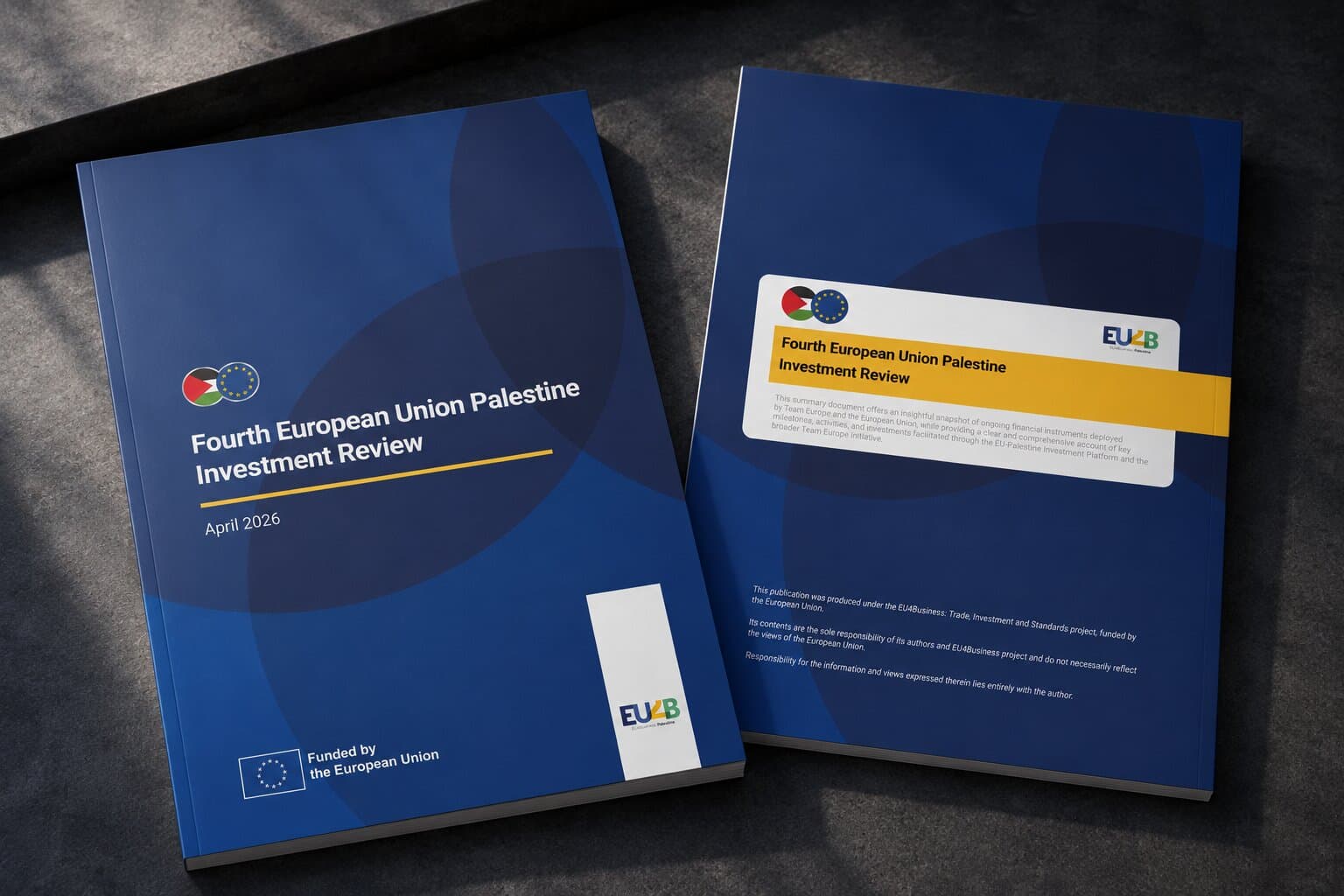
Project Card
Client:
EU4B - Palestine
Industry:
International Development
Services:
Publication, Editorial
Timeline:
2 Weeks
Collaborators:
Challenge
The review had to be assembled rather than authored: a large body of data and several older editions, in different shapes and different templates, to be combined into a single publication. It also does two jobs at once — a public account of how European funding reaches Palestine, read by ministries, financial institutions and prospective investors, and a working reference someone consults for one figure. So the design had to reconcile inconsistent source material into one system, and make a document that is read cover to cover and dipped into behave equally well either way.
Goals
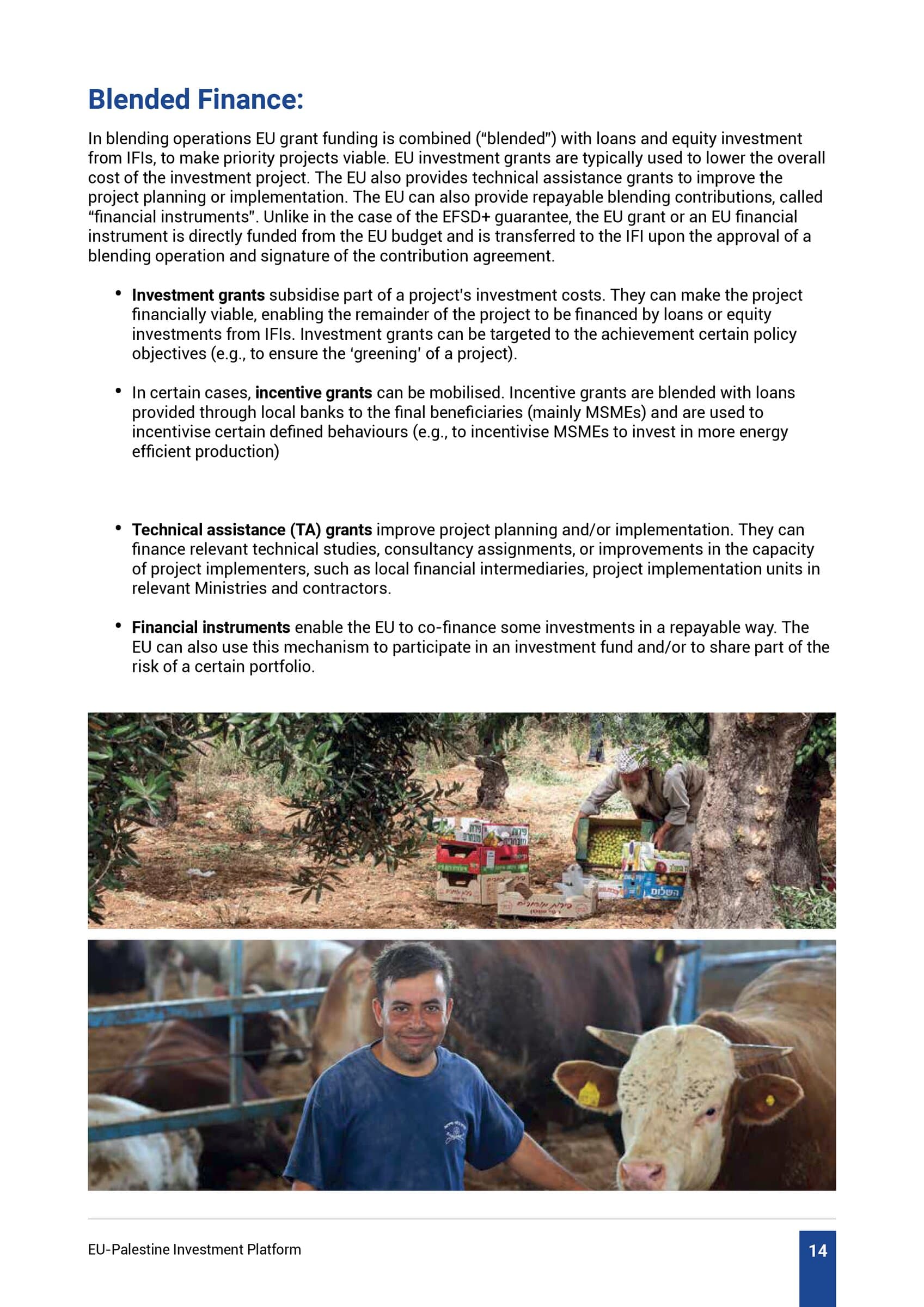
Design a system rather than a set of pages: one grid, one typographic scale and two colours that any contributor's material could be poured into. Give the recurring content — the partner profiles, the activity timeline, the financing instruments — a fixed template, so the fourth edition sets the pattern the fifth can inherit, and keep every figure legible at the size a report is actually read.
The Spread
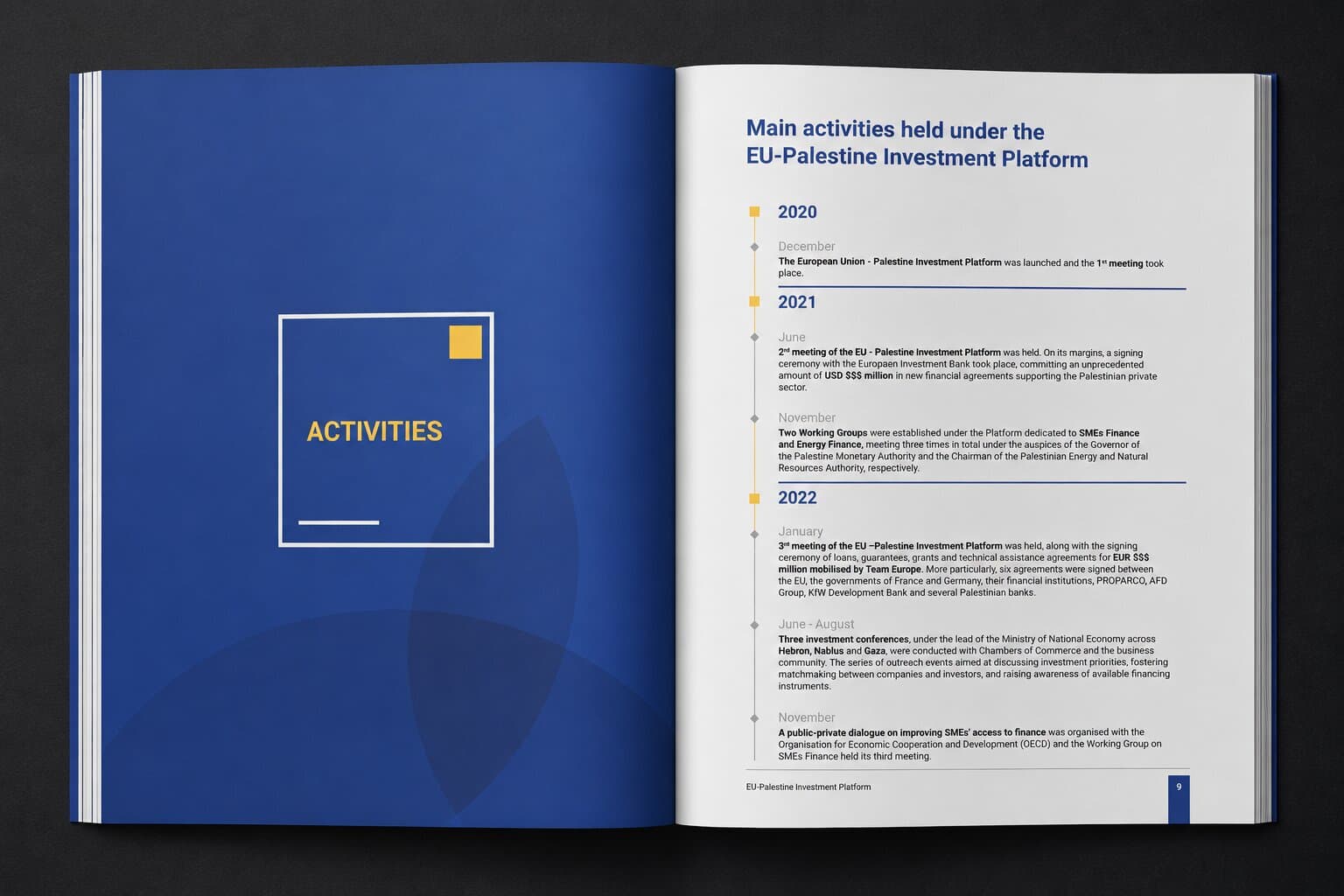
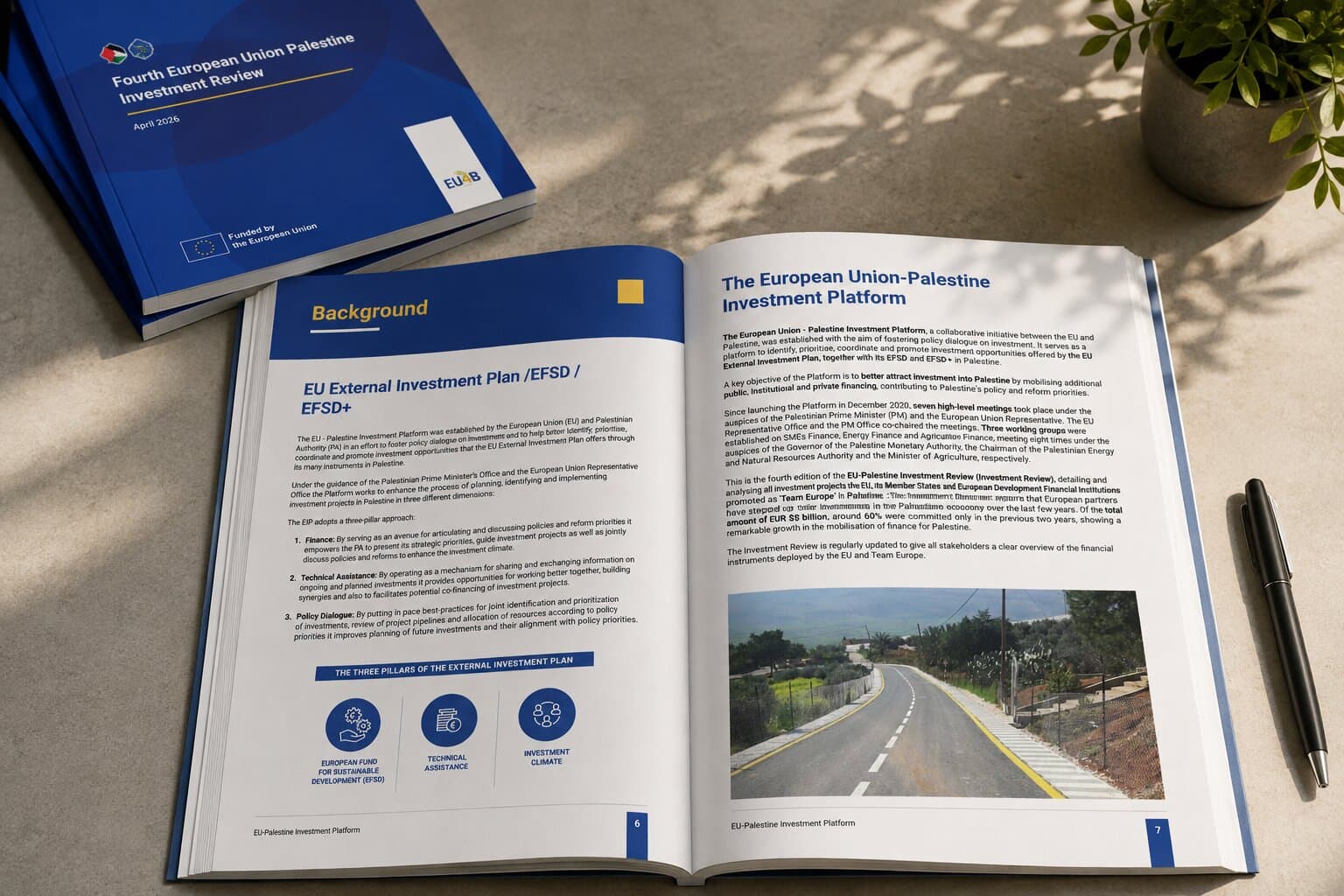
The double page is the unit of design, not the page. A section opens on a full-bleed blue plate with its title set in yellow, and the facing page carries the content — so every chapter announces itself before it asks to be read.
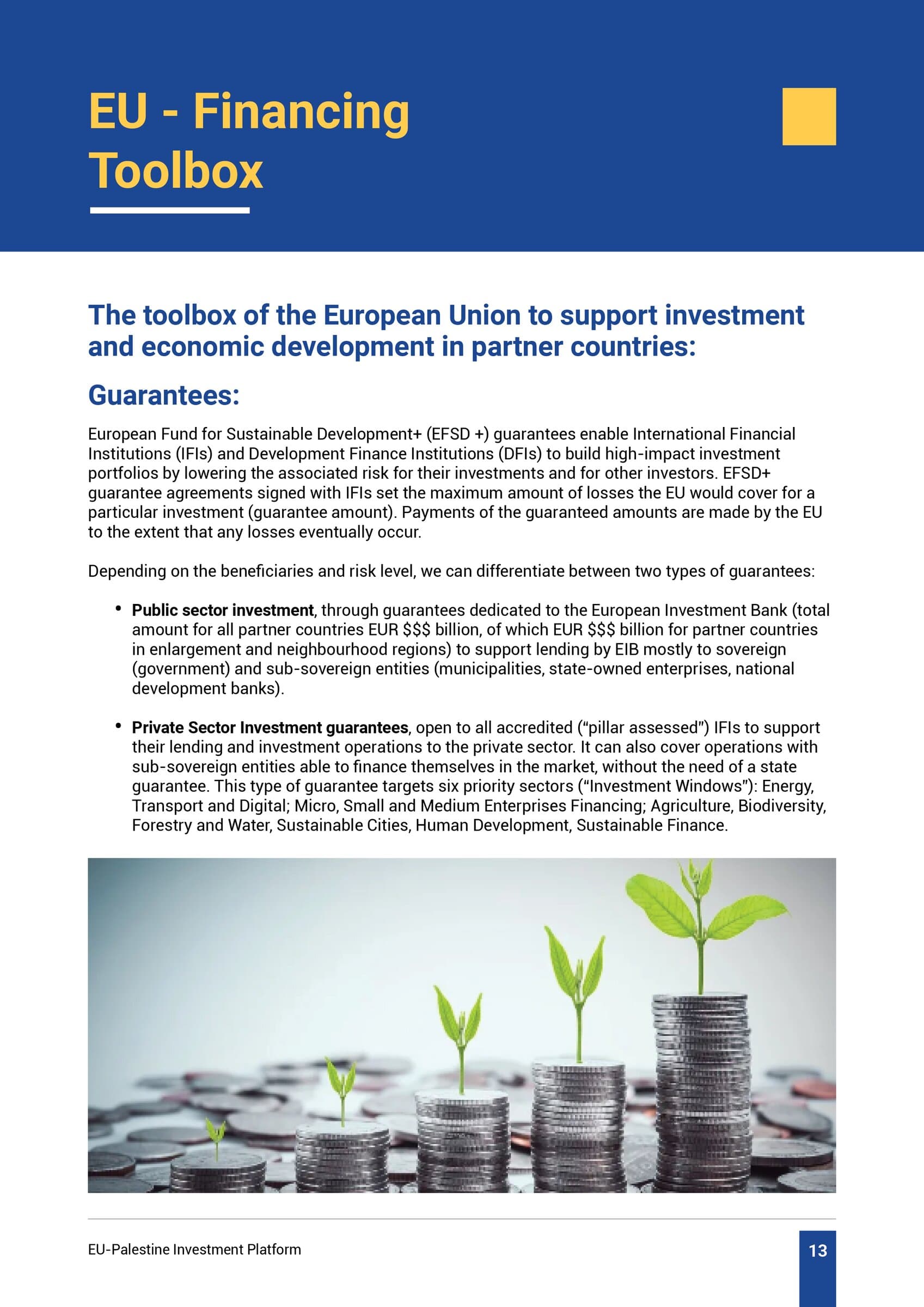
Typography
Hierarchy, scale and reading rhythm. One humanist sans carries the whole document, and four steps do all the work: a section title, a chapter heading, one body size, and a bold lead-in that lets a reader skim for an instrument without a second typeface being introduced to flag it.
Section Title
Background
39/44 · Bold · Upper/lowercase
Chapter Heading
EU External Investment Plan /EFSD / EFSD+
24/28 · Bold · Upper/lowercase
Body Copy
The EU - Palestine Investment Platform was established by the European Union (EU) and Palestinian Authority (PA) in an effort to foster policy dialogue on investment.
10.5/16 · Regular · Sentence case
Bold Lead-in
1. Finance: By serving as an avenue for articulating and discussing policies and reform priorities it empowers the PA to present its strategic priorities.
10.5/16 · Bold (lead-in only)
Layout
One grid runs under every page: A4 with a 2cm margin. Move across the skeleton to uncover the page it was drawn from.
Visual Elements
Two colours do all the work. Institutional blue carries the structure — headers, rules, page markers and data panels — and a single yellow marks the entry points. Flags, partner logos and photography are the only other colour, which stops eight contributing institutions from competing.
Contribution share
- Sweden17.1%
- Netherlands1.7%
- Luxembourg0.45%
- EU5.75%
- EIB34.1%
- Germany10.2%
- EBRD8.6%
- France15.15%
- Italy6.6%
Figures strip

Areas of activity with investment instruments in Palestine

Total amount of ongoing interventions with investment instruments in Palestine

Number of initiatives
Small and Medium-Sized Enterprises, Energy, Green Economy, Banking, Guarantees, Micro-Finance, Technical Advice.
EUR $$$ million
14
The System in Use
Section plates, reference pages, partner profiles and data spreads — the same grid, the same two colours and the same typographic scale, whatever the page has to carry.
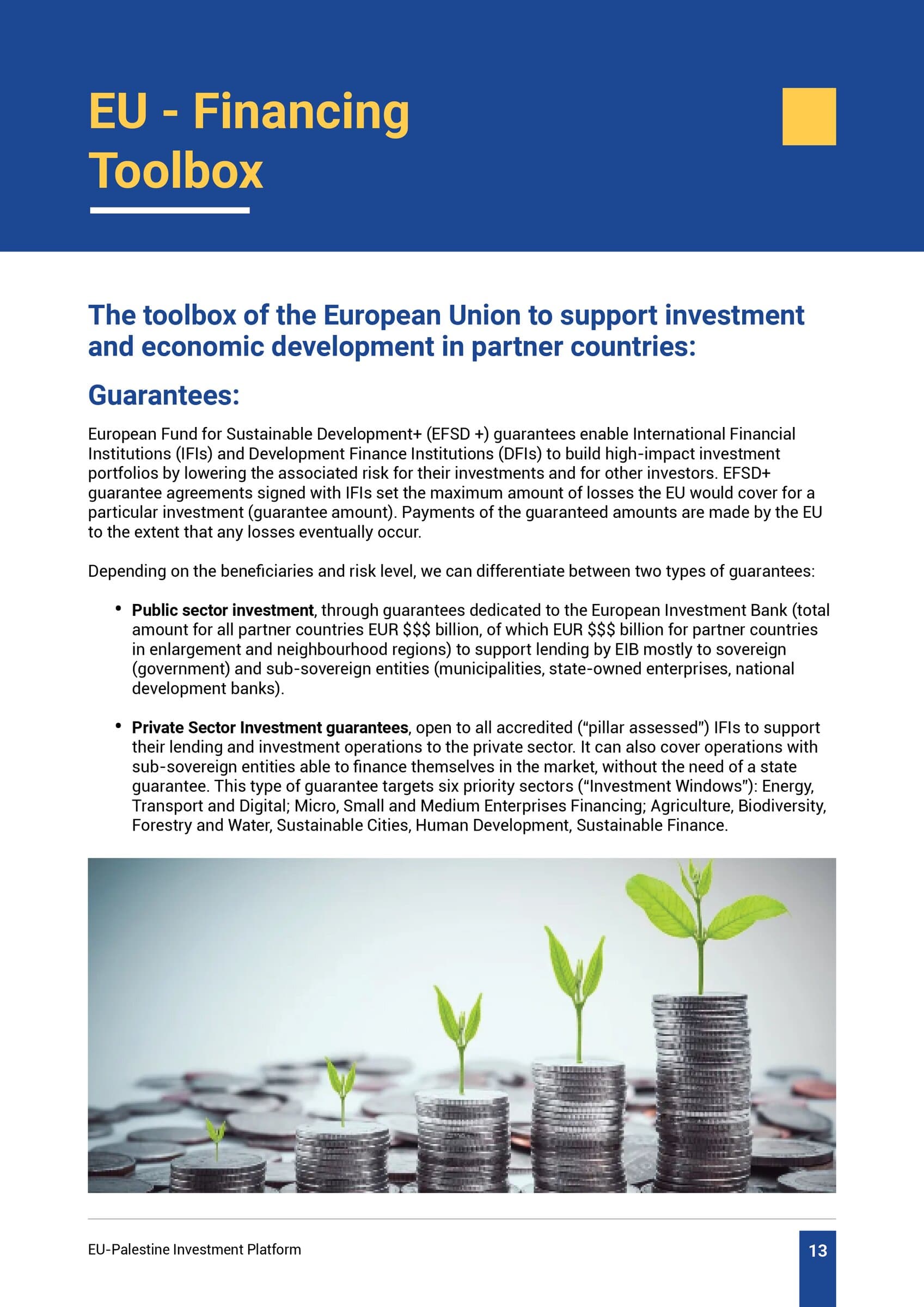
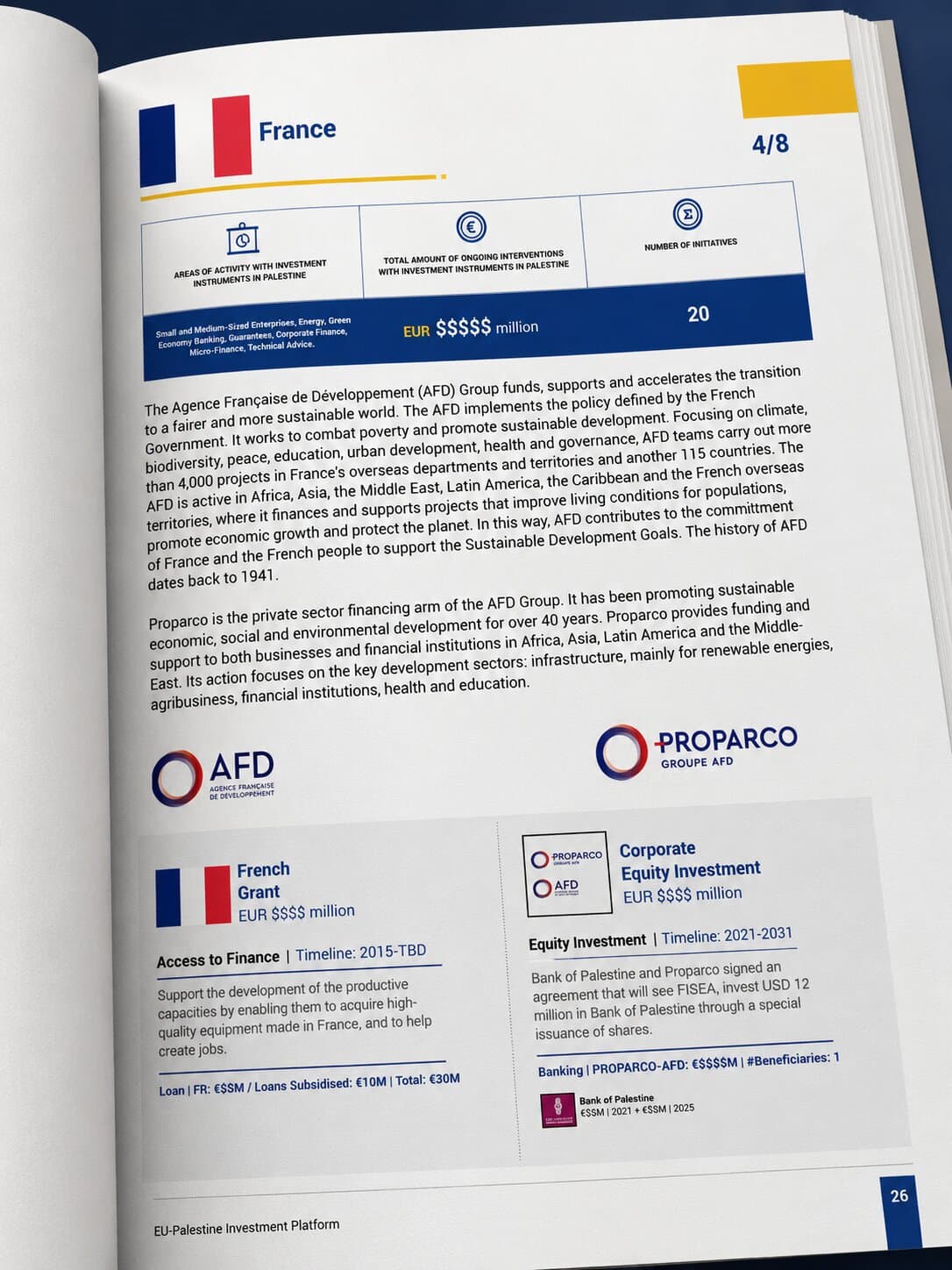
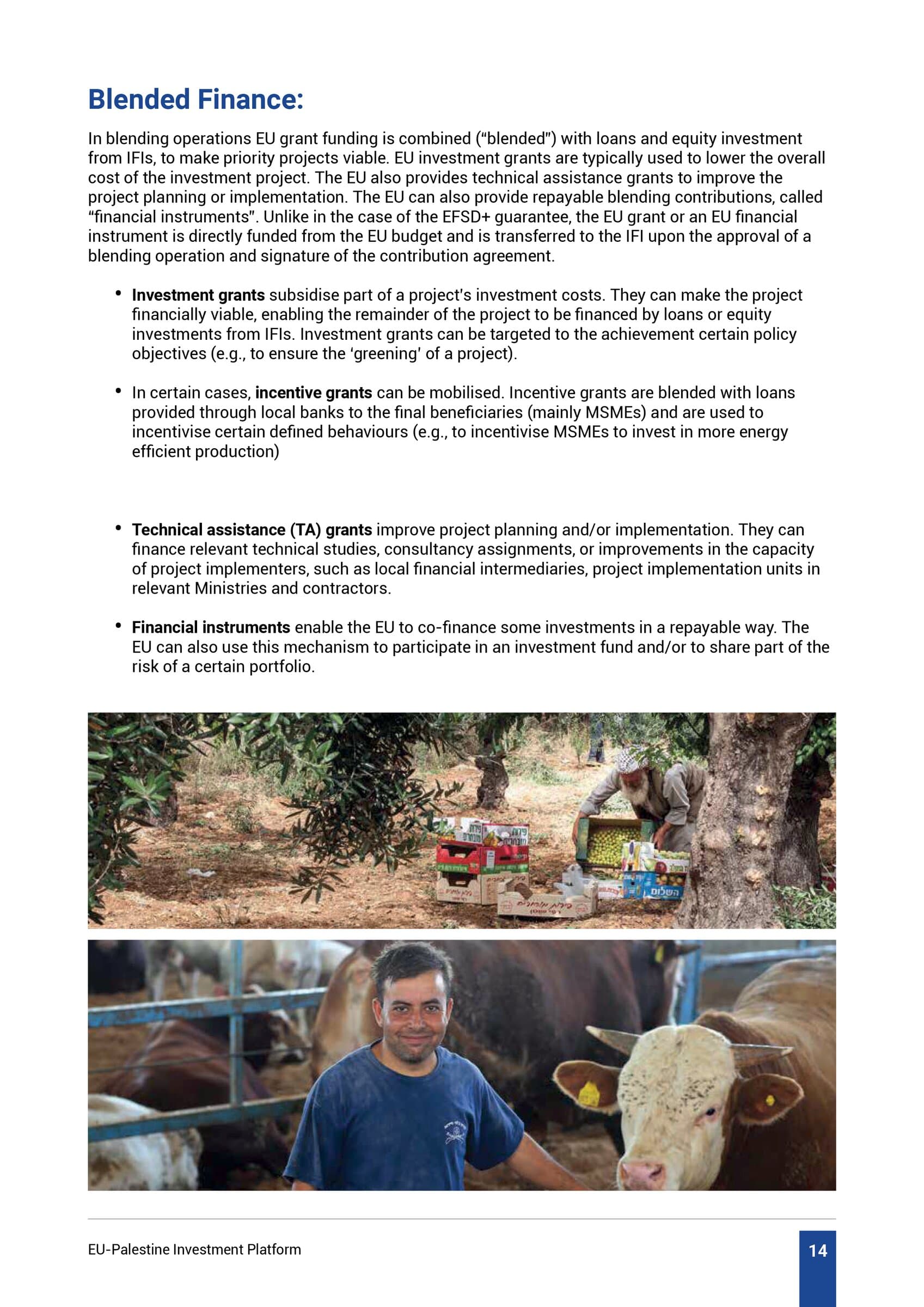
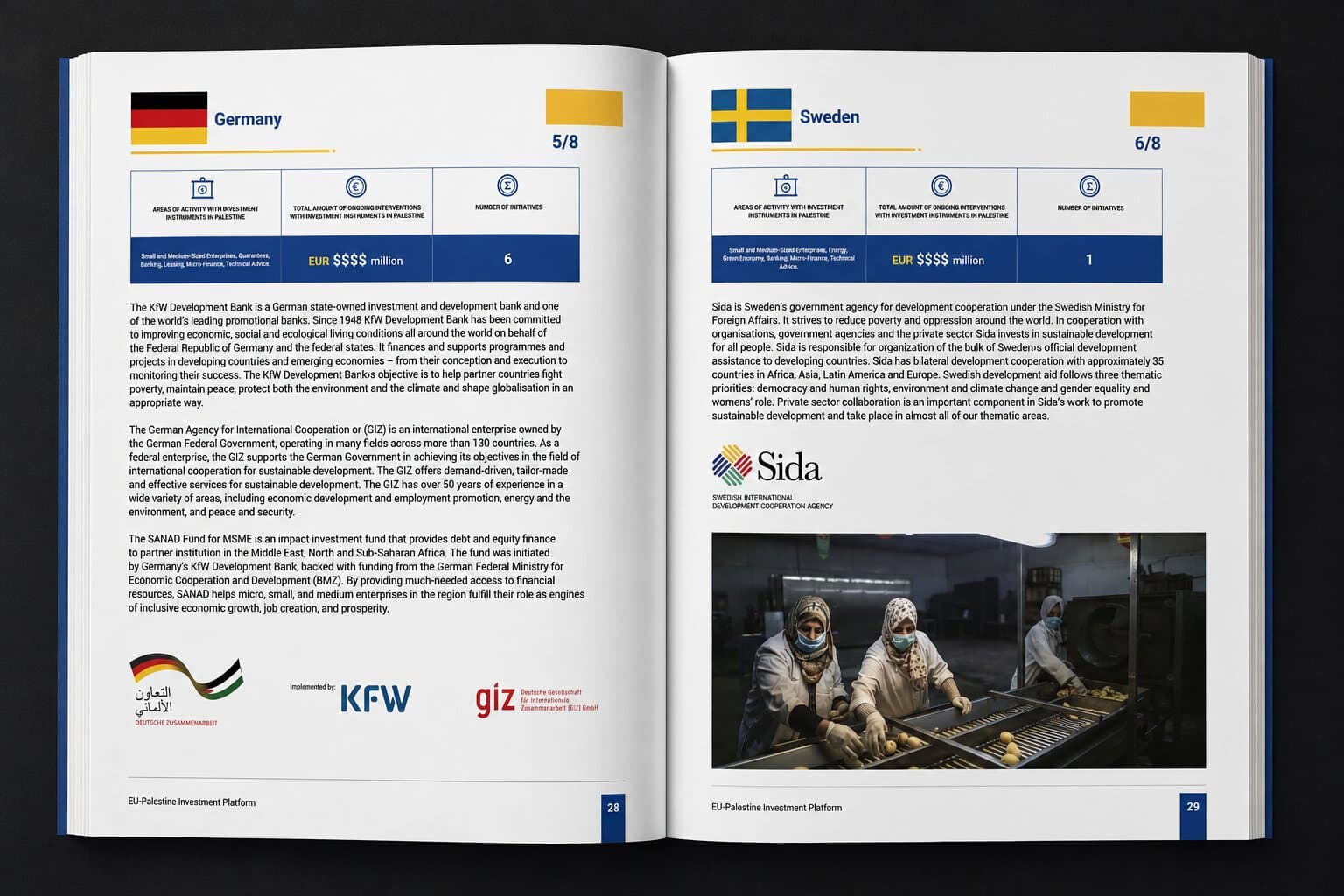
Scaling the System
The system was built to be handed on. A partner profile, a data spread and a page of continuous prose all resolve to the same grid, the same two colours and the same four typographic steps, so the next edition can absorb new contributors without redesigning the page — and a reader who learned the first twenty pages already knows how to read the rest.
Rights & Credits
The Fourth European Union Palestine Investment Review was produced under the EU4Business: Trade, Investment and Standards project, funded by the European Union. Content, imagery and institutional marks remain the property of the European Union and the contributing institutions, and appear here for portfolio purposes only.
Conclusion
Business Impact
The fourth edition ships as a system rather than a layout. The recurring content — partner profiles, the activity timeline, the financing instruments — now has a fixed template, so material from eight contributing institutions can be placed without redesigning the page, and the next edition starts from a document that already knows its own rules.
Reflection
The discipline was in resisting variety. A report this dense invites a new treatment for every kind of content, and each one added would have made the document harder to read and harder to hand on. Holding to one grid, one family and two colours let the design disappear and the figures carry the page.
Satisfaction Meter
So... What's the plan?
Tell us where you're headed, and we'll help you get there!
Drop us an email!
info@eureka-creative.studioEureka Creative Studio 2026